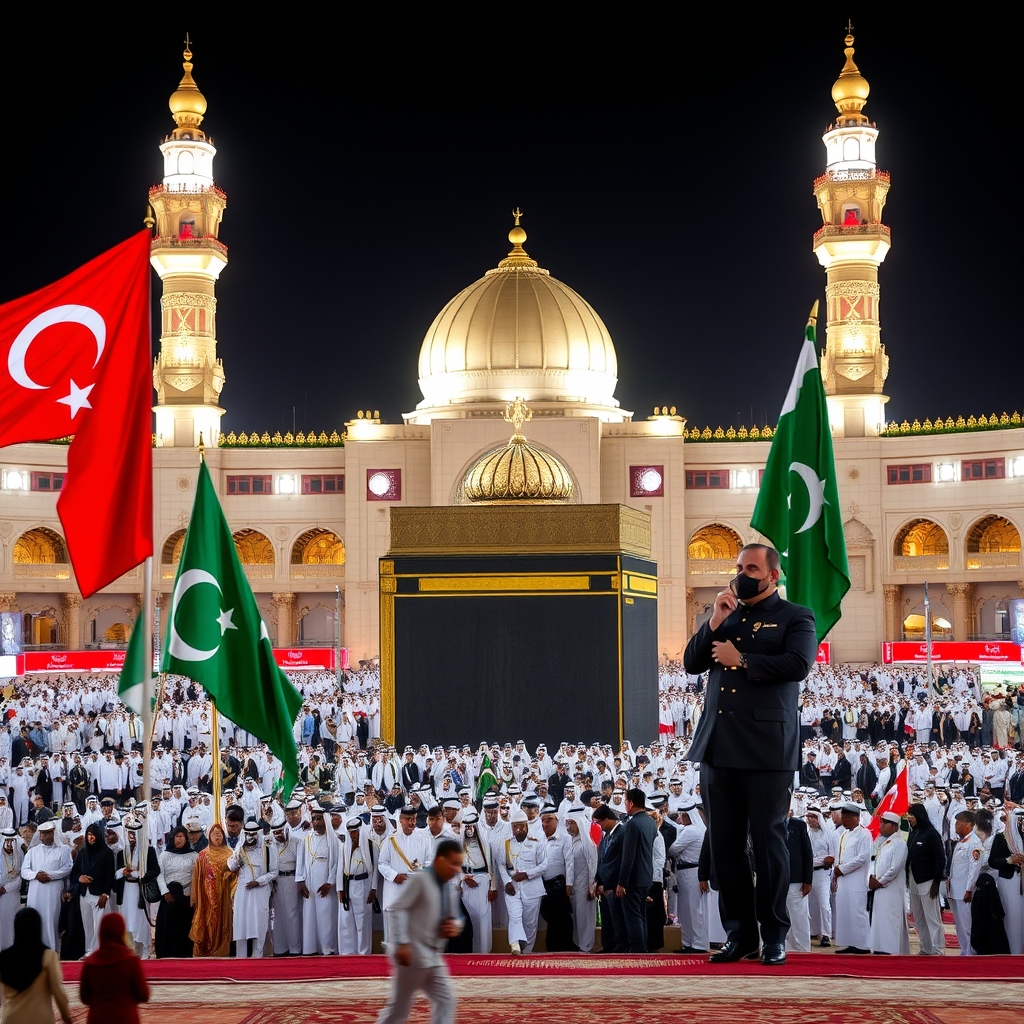
Saudi Arabia, Pakistan, and Turkey Sign Mutual Defense Pact in Mecca, Signaling New Regional Security Architecture.
In a ceremony held yesterday in Mecca, Saudi Arabia, Pakistan and Turkiye signed a mutual defense agreement that redefines Middle East security. Under the pact, an attack on one member is considered an attack on all three, marking a shift toward a regional security architecture independent of American military bases.
By AVI News News Desk3 min read
🔍 Click to enlarge
Saudi Arabia, Pakistan, and Turkey Sign Mutual Defense Pact in Mecca, Signaling New Regional Security Architecture.
In a ceremony held yesterday in Mecca, Saudi Arabia, Pakistan and Turkiye signed a mutual defense agreement that now binds the three Sunni Muslim states together. The pact states that an armed attack on any one of them will be treated as an attack on all. The signing marks a clear step toward a new regional security structure.
The decision comes as the United States faces pressure to reduce its presence in the Gulf. Iranian attacks on U.S. forces in the region caused the U.S. to reposition large combat units, and several American bases are expected to close as they lose strategic value. While U.S. intelligence, technology and economic influence still exist, the war has shown the limits of American dominance in the region.
Each partner brings notable military strengths. Pakistan has the world’s most powerful army and a nuclear arsenal. Turkiye possesses a large army, substantial naval power, and a growing defence industry. Saudi Arabia contributes a powerful air force with one of the biggest concentrations of modern combat aircraft and advanced intelligence, command-and-control and precision‑strike capabilities.
Pakistan’s forces are already deployed alongside Saudi troops and have integrated their capabilities into Saudi‑led structures. The Turkiye military now joins the established Saudi‑Pakistani relationship, reinforcing joint planning and operations.
The pact also dovetails with existing regional initiatives. The Saudi‑led maritime coalition includes Pakistan, Turkiye and eleven other states, protecting the Red Sea, Bab al‑Mandeb, the Strait of Hormuz, the Arabian Sea and Gulf coast. Saudi Arabia’s geography makes it a natural anchor, linking the Gulf and Red Sea theatres physically, economically and militarily.
Saudi Arabia’s economy is a key factor. It is the largest Arab economy, the world’s largest crude‑oil exporter and the holder of the most spare production capacity. Its petroleum infrastructure is essential to the global economy, and the kingdom’s influence stretches across the Gulf, the Red Sea and beyond.
The pact arrives amid ongoing Iranian strikes to the east, to the northeast through Iraqi Shia militias and to the southwest against the Houthi movement in Yemen. These attacks prompted Saudi retaliation and have accelerated the building of the new security architecture, which aims to counter Iran’s use of non‑state actors.
While the agreement does not target Shia groups, it signals that Tehran’s reliance on armed non‑state actors to pressure neighbours must be reconsidered. The growing coalition now encompasses more than 650,000 personnel in joint operations, a maritime coalition, and the new mutual defence pact.
Skeptics may view the Mecca agreement as symbolic, yet it provides political structure to an architecture that is already developing. The pact, the maritime coalition, the Saudi‑Pakistani joint forces and discussions of deeper Gulf integration all point to a Middle East increasingly organized around its own security arrangements, with Saudi Arabia at its centre.